

Diabetes in Dogs: Symptoms, Insulin, Diet & Care
Hi everyone and welcome to this first episode of Val Talk’s Pets 2026. I hope everyone had a wonderful holiday and the fur kids had a safe, great time. To […]
 play_arrow
Spotlight on the Maltese Dog: A Charming Little Companion With a Big Heart Val Cairney

 play_arrow
Food Allergies and Sensitive Stomachs in Dogs and Cats: What Pet Parents Need to Know Val Cairney

Hi everyone and welcome to this episode of Val Talk’s Pets. For a while now, I have been getting questions on a fairly steady basis about a dog or cat that has a sensitive stomach or food allergies. It’s a challenging thing to deal with a dog or cat with this issue, so let’s see what we can figure out when it comes to sensitive stomachs and food allergies.
The reason sensitive stomach and food allergy goes hand in hand is due to the issue that many food allergies create a sensitive stomach. Some pets are not necessarily allergic to a food specifically, but they have an intolerance to the food causing reactions like a stomach issue. The difference between a food allergy and an intolerance is that a food allergy involves the immune system. Reactions can be life-threatening. Food intolerances involve the digestive system and are not generally dangerous but are certainly challenging.
To determine which one you are dealing with let’s first look at food allergy symptoms. First is the itching. In dogs, you will most likely see redness or scratching or licking specific areas like the face, ears, paws, armpits and groin. Dogs will have recurrent or chronic ear infections, and the ear canal can be quite inflamed. Other symptoms include rashes, hives, dry skin or scabs. Some dogs will have thinning or balding patches often caused by the constant licking.
Cats will often over groom causing hair loss. They too can have raw sores, or small crusted bumps around the head and neck.
With both dogs and cats, some gastrointestinal upset can occur as well with vomiting and soft stool.

Determining what is causing the reactions can be difficult. Some pet parents have an allergy test done on their pets to see what they are allergic to. But I can tell you, this is a bit of a rabbit hole. I have seen people come in with a list as long as your arm and they are frustrated and daunted by the task of trying to find food that their dog is not allergic to. The big offenders are grain and certain proteins.
In terms of grains, many pets can be allergic to corn, wheat, soy or beet pulp. Some dogs may react to oats, millet or rice. But the lower nutritional value grains like corn and wheat are usually the culprits. When pets have itchy, red ears and lick their paws incessantly, you can usually point the finger at these grains. In terms of proteins, chicken and believe it or not, beef are the two big allergens. And apparently clinical studies have shown that beef outranks chicken. This is really interesting because some pet parents will choose beef over chicken if the pet is having a reaction.
Let’s look at some numbers.
Beef accounts for roughly 34% of documented food allergy cases in dogs.
Milk, cheese and other milk proteins triggers about 17% of cases
Chicken is roughly 15%
Lamb is about 5%
The symptoms of a protein allergy differ a bit from the grain allergy by incorporating the stomach in the itching or redness. Digestive upset will also accompany these symptoms.
In cats, they follow pretty much the same list except for them, fish is the number two culprit after beef. The one positive is that cats don’t actually have a large propensity to food allergies like dogs do. If you have a Siamese cat however, they are the one breed of cat that is prone to food allergies.

So, what do you do? I can tell you from experience, I have dealt with pet parents that are absolutely at the end of their ropes dealing with their dog and some cats that are just allergic to everything. It is very trying and can be quite expensive as you try so many options.
So, what are your options?
First, you have to calm the allergic reaction. When the body is having a reaction, the immune system mistakenly overreacts to a harmless substance and releases strong chemicals into the body. The immune system may overreact by producing antibodies that “attack” the allergen. To be even more specific “certain types of white blood cells called eosinophils (ee-oh-sin-o-filz) and sometimes basophils (bay-so-filz) increase because they manage allergic responses. This means that this response has to be calmed and the only way to do this is by removing the substance. Easier said than done. We don’t know what is causing the reaction! In this case there are a few options to begin with.
First, the dog or cat’s diet must be stripped right down. All grains must be removed. And this means checking not only the food, but their treats as well. Next is to choose a protein the pet has never had. They cannot have a reaction to a protein they have never had before. Have a look at the proteins that are available that your pet hasn’t had. It could be lamb, fish (not for cats) pork, venison, rabbit, duck, turkey and some novel proteins like kangaroo, elk, bison, and wild boar. There are a few to choose from.
And another protein that is available, but you may have to ask for it to be ordered in for you, is black soldier fly larvae. Yup, this is a new one. It is highly digestible and won’t be on the list of proteins the cat or dog has been overly subjected to. The food chosen if going in this direction, should be grain free, a protein that has never been given and be a limited ingredient. This means that you can guarantee that the food does not have any other protein in the formula other than the one listed.
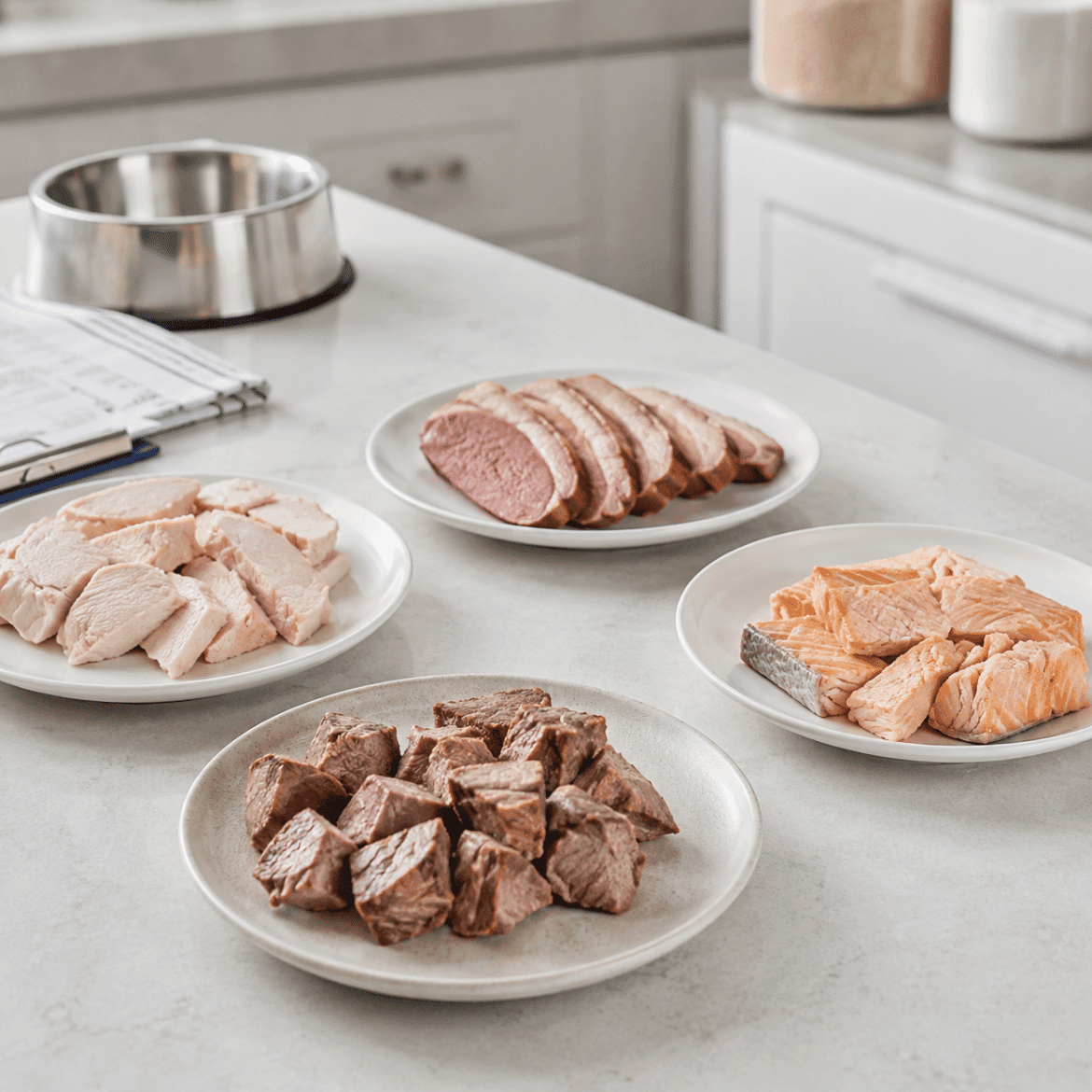
The other approach in stripping down the diet is to pick a protein available that is on the so-called safe list, purchase it at the grocery store and then boil it or bake it with nothing added. Next is to make up some plain white rice, possibly brown rice. Now, I know that rice does show up on the grain allergen list, but a reaction is highly unlikely, and it is gentle and highly digestible, so I would go for it. For the next 6 weeks at least, the dog will eat this basic diet. You can also add pureed pumpkin, and a good probiotic would be very helpful.
For the cat, boil or bake the protein and puree it a bit so it resembles more like a minced or pate formula. Add the probiotic if the cat will eat the meat with it added and don’t worry about adding any grains. Remember, they are carnivores. If the reaction is not calming within a few days, change the protein and make sure you make note of everything you are doing. This is the only way to start to figure out what is the allergen. Some dogs are allergic to anything with feathers, so no chicken, turkey or duck. However, some dogs are highly allergic to chicken but can tolerate duck very well.
The next option is to try raw food. I find that raw feeders fall into two categories. Those that want a more ancestral diet for their pet and those who have pets that are allergic to everything and having tried everything they move to raw for help. Can it be the answer? In many cases, yes. Is it going to be the magic cure? Not with every pet.

Other things that you can do when trying to deal with a pet with food allergies are to add as I said, a good probiotic. Remember a good probiotic should have 9 strains and the Colony Forming Units, the CFU’s should be off the charts into the 3 billion area. Dandelion either in powder form or in a steeped tea form can really help. Dandelion leaves and roots are highly effective in calming allergic reactions and managing allergic reactions. Remember, when the body is in an allergic reaction, everything is inflamed, so looking for supplements with anti-inflammatory properties is a really good direction.
The idea with all of these directions is to try and find what is the allergen. Doing an allergy test at the vet can give direction, but I suggest looking at the larger numbers and try not to get overwhelmed by the list. It’s possible the pet may have a reaction to something further down the list, but it is miniscule and would require a large exposure on a regular basis.

All right, let’s switch to intolerances now. An intolerance could be to a specific food or ingredient. Reactions here are going to be more gastrointestinal with gas or bloating, possibly some vomiting or loose stool. The trick here is to determine that the pet is having an intolerance reaction as opposed to acid reflux, irritable bowel syndrome, celiac disease or inflammatory bowel disease.
Both dogs and cats can also have an enzyme deficiency known as Exocrine Pancreatic Insufficiency or EPI. If this is the case the pet’s pancreas does not produce enough digestive enzymes to break down fats, proteins and carbohydrates. Chronic diarrhea would have you look to this.
In terms of some of the other symptoms of an intolerance, the gas and gurgling or rumbling of the tummy is a real clue. And farting and rumbling or diarrhea, even vomiting can occur within a few hours of eating. This reaction will be your easiest symptom to go in the direction of an intolerance as opposed to an allergic reaction. However, finding the culprit could be tricky because it could be an ingredient in the kibble or treat that you wouldn’t suspect. So, again, strip everything down and then add back ingredients one at a time and see where the reaction lays. Tundra does not do well with chicken. I would not say he has an allergy to chicken. He probably has an intolerance because he will gas you out of the room if he eats chicken.
Cats will follow symptoms similarly to dogs with an intolerance. Throwing up soon after eating especially undigested food is a really good indicator. A lot of people think their cat ate too fast and that is why they have thrown up undigested food, but the real reason is probably more to the fact that their stomach could not handle a certain ingredient. Cats as well can have diarrhea and gas and also weight loss.
So, here is the thing when trying to deal with either an allergy or an intolerance. Something is going on with the food, whether it is grains, a nutraceutical or protein. The low-end grains are usually suspect. Corn, wheat, soy are not high on the nutritional chart and for a cat; well when was the last time you saw a cat eat corn? In terms of nutraceuticals, although they are health-boosting the biological compounds, proteins, or flavourings can react adversely on a pet’s tummy just like regular food. And proteins of course are top of the list for intolerance depending on the protein.

It’s a challenge no doubt, when you have a dog or cat scratching, red, throwing up or having diarrhea. It is a process of elimination and charting what you are doing is essential. I would suggest however, that any food suggested, be it from the vet or on-line, you take a very hard look at the ingredient panel. Are there any suspect grains? Are there any other proteins hiding down the list that can be trouble? Hydrolyzed kibble can help. It is a type of kibble where the proteins are broken down into tiny peptide fragments so a pet’s immune system cannot recognize them as allergens. It’s an option but again, look hard at the ingredient panel and there are options in pet specialty that you can look at as opposed to higher priced prescription blends.
I would also suggest really giving all these options a good try and adding the supplements that boost and support the immune system while it fights the allergen. Personally, I would do everything to stay away from Apoquel because I know there are lots of choices to reduce inflammation that is causing the itchiness.
So, there you have it. Allergies and intolerances can be very challenging but not unmanageable. It will just take patience, perseverance and research. That’s your best tool in your toolbox because as I say, knowing is caring.


Hi everyone, and welcome to Val Talk’s Pets, the forum for pet parents and enthusiasts alike. So, I have been working in the pet industry now for almost 10 years and, on a daily basis, I handle a lot of issues and questions arising from pet parents. I am not a veterinarian but I do have certifications in Canine, Feline, Small Animal, Fish and Herptile and Avian Health and Nutrition from the University of California, Davis Extension, the Vet College.

Hi everyone and welcome to this first episode of Val Talk’s Pets 2026. I hope everyone had a wonderful holiday and the fur kids had a safe, great time. To […]



Comments are closed.